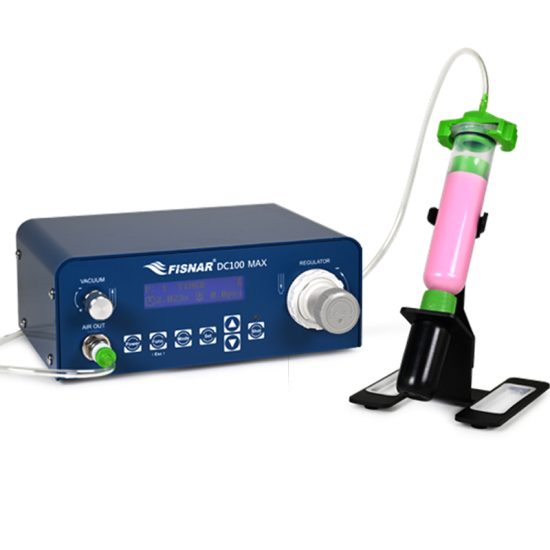
 The Fisnar DC100 MAX Benchtop Digital Liquid Dispensing Controller is a versatile, high precision dispenser suitable for a wide variety of critical dispensing applications; from microdot deposits, lines, to potting and encapsulation. The advanced user-friendly dispense software features a wide range of intelligent functions, allowing the user to maximise the accuracy, control, and monitoring of their application. We interviewed Rob Campbell, Global Product Manager for Fisnar, to get some insight on how the DC100 MAX can help you improve your production process.
When is precision important in dispensing liquid adhesives?
Industrial electronics, mobile electronics, and medical wearables keep getting more compact; from smartphones to hearing aids so small that they’re barely noticeable. When dispensing liquid adhesives, you need a way to deposit smaller shot sizes onto components and pcb assemblies. Smaller dots require greater precision.
Are smaller shot sizes the only thing that’s driving demand for precision?
No. Adhesives are using advanced chemistries and becoming more complex, more expensive, and more difficult to dispense. You need to dispense these fluids reliably and consistently whilst reducing material waste and improving yields. Let’s say you want to dispense a volume of 0.1 ml ±3%. In this case, a basic dispenser with deposit sizes of ±10% cannot achieve this.
What’s an example of a more complex adhesive?
Increasingly, design engineers are specifying conductive adhesives that contain specialised fillers. These adhesives can be electrically conductive, thermally dissipating, or both. The chemistry of an adhesive like silver-loaded epoxy is complex, and precious metals are expensive. With their high viscosity and large filler particles, conductive adhesives like this are also challenging to dispense.
How is the DC100 MAX able to achieve a accuracy and repeatability?
The DC100 MAX uses a fast-acting solenoid and a high-precision regulator. These integrated components provide high accuracy, robust capabilities, and exceptional results. By carefully controlling the flow of compressed air to the syringe barrel, the DC100 MAX can achieve a very accurate deposit size. The stability of the flow rate and the repeatability of this flow are critical. When external compressed air is supplied to the machine, the regulator ensures that the pressure inside the unit remains constant and doesn’t drift. When the machine is actuated, it opens the valve at the same speed every time. This allows air to flow into the syringe’s barrel, which closes at a rapid rate and with a high degree of repeatability. Using an industry-best regulator and solenoid makes this possible.
How does the DC100 MAX maintain consistency?
The DC100 MAX can adapt and change its dispensing parameters to maintain a consistent shot size over the course of a working shift or a batch of parts. That’s important because of a phenomenon known as “full-to-empty syndrome”, and because the viscosity of a liquid adhesive can change over time. During dispensing, the syringe that’s used contains liquid adhesive and air. Remember that air is compressible, but that fluids are technically incompressible. As liquid adhesive is dispensed from the syringe, the volume of air increases. In other words, there’s now a larger amount of air to compress for the next shot, which affects the volume of material being dispensed. Users also like the control and calibration that the DC100 MAX provides.
How can you control dispensing parameters?
The DC100 MAX lets you change dispensing time incrementally or on the fly, and by either total elapsed time or shot count. Typically, shot count is used. Let’s say there are 100 shots in a syringe. The user could adjust the dispense time as needed, or have the unit automatically adjust this parameter every 10 shots to account for differences caused by “full-to-empty syndrome”. Liquid adhesives that undergo changes in viscosity usually thicken over time. Temperature is also a factor, and a manufacturing facility may be considerably warmer or cooler depending on the time of day or the season. By adjusting the dispensing parameters, a user can change the time vs. viscosity curve into a straight line. Mathematically, increasing the dispensing time accounts for the increase in viscosity.
Does it work with Industry 4.0?
Manufacturers want real-time feedback, machine-to-machine communications, and the ability to control dispensers from a human-machine interface (HMI). This requires connectivity and communications. The DC100 MAX has an I/O interface for data exchanges and can be remotely controlled. It uses MODBUS, a client/server protocol, for M2M communications. An operator can attach a barcode scanner to the DC100 MAX. Then, instead of choosing when to dispense material or which program memory address to use, the operator can simply scan a barcode. This user-friendly feature changes the unit’s parameters while preventing the operator from making a mistake. In turn, eliminating human error reduces part rejects.
What about calibration?
The machine’s pressure gauge can be calibrated to an atmospheric pressure. This is important if you need to run the same manufacturing process at different geographic locations due to the changes in atmospheric pressure. In turn, this promotes consistency in globally distributed manufacturing while allowing equipment to be moved and then fine-tuned.
Where is the DC100 MAX used?
This machine can be used on either a single-piece-flow production line that’s operator-controlled, or with batch processing. Although the unit is not designed for fully automated production, there is support for automation. Manufacturers can connect the DC100 MAX to an industrial robot or integrate it with an advanced robotics system or other automated machine environment. Manufacturers of all sizes can use the DC100 MAX. Graduate-level researchers and startups that are building products also need the ability to dispense adhesives with precision. Design engineers will like how this unit uses adhesives that are packaged into prototype-friendly small-capacity syringes and cartridges instead of large pails or containers.