 Two part adhesives, potting compounds and similar materials need to be mixed in the correct ratio of the two parts in order to achieve the properties stated on the product data sheet.
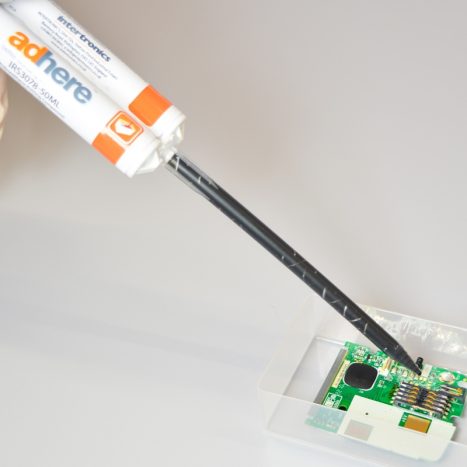
In many cases, this is easy. Most of our two part structural adhesives are packaged in two-part cartridges with static mixing nozzles, so the mix ratio is predetermined when dispensed. Materials which are formulated to be “cartridge-able” are required to have simple mix ratios (1:1, 2:1 and 10:1 being the most common). And you will have figured out that the mix ratio for materials in cartridges is based on volumes of the two parts.
But mix ratios are not always stated on data sheets volumetrically. In instances where the materials are packed in bulk (jars, bottles, cans, etc), the mix ratio may be quoted by weight. This is helpful, because you will often have to weigh out the proportions of the two parts prior to mixing them.
Problems can arise when confusing mix ratio by weight with mix ratio by volume – because they may very well not be the same. For example, a thermally conductive adhesive could be quite heavily filled in order to achieve its conductive properties. The density of the filled part (say Part A) could be as much as 1.6 g/cm³, and the unfilled component (Part B) as little as 1.0 g/cm³. The data sheet states the mix ratio to be 20:1 by weight. What is that by volume?
Let’s convert weight to volume for each part:
For Part A: 100 g ÷ 1.6 g/cm³ = 62.5 cm³
For Part B: 5 g ÷ 1.0 g/cm³ = 5 cm³
Some simple division calculation shows that the mix ratio by volume turns out to be 12.5:1. Quite different from 20:1.
 It is important to look at the product data sheet for some clues. Does the ratio say by weight or by volume? Does it give the density of each of the two parts? Sometimes the density will be given by a specific gravity (SG) number – this is the ratio of the density of a substance to the density of water, so is given without units, but for the purpose of understanding mix ratios, can be used in the same way as density. In our example, it’s important to note that this significant difference between the weight ratio (20:1) and the volume ratio (12.5:1) is due to the different densities of the two parts. If the densities are the same, the mix ratio by weight and the mix ratio by volume will be the same.
As an illustration, a polyurethane potting and encapsulating compound was mixed. Test 1 had the correct 100:60 ratio by weight. Test 2 had a 100:50 ratio by weight — which is the correct ratio by volume. This ostensibly small error kept the PU from developing full hardness, and changed the way hardness decreased with increasing temperature. This example clearly illustrates why it’s crucial to pay attention to whether a mixing ratio is specified by weight or by volume, as mixing them up can lead to incorrect proportions and potentially compromise the material’s performance.
Always check the manufacturer’s instructions for the correct mixing method and ratio (volume or weight).